Default servicing, built into the system that services the loan.
Move default work out of disconnected tools and into a configurable servicing environment. MortgageFlex combines collections, foreclosure, bankruptcy, loss mitigation, replevin, supplemental actions, borrower assistance, documents, reporting, and third-party collaboration in one task-driven platform.
One platform. Configurable workflows. Clear control.
- Default modules operate inside the servicing platform — not a bolt-on
- Servicer-controlled templates, queues, tasks, holds, and milestones
- Role-based collaboration, APIs, documents, audit history, and reporting
- Supports full-service ops and default-only with an external system of record
A coordinated default lifecycle, not a single event.
- Borrower contact, collections, notices, foreclosure, and bankruptcy together
- Templates define steps, roles, dates, dependencies, holds, and approvals
- Workflows replace spreadsheets, email chains, and manual calendars
- Configurable for residential, chattel, manufactured housing, and specialty
Every default activity, on one workflow engine.
Collections
Queue-driven worklists for pre-delinquent, 30-day, 60-day, and 90+ day activity with triggered notices.
Foreclosure
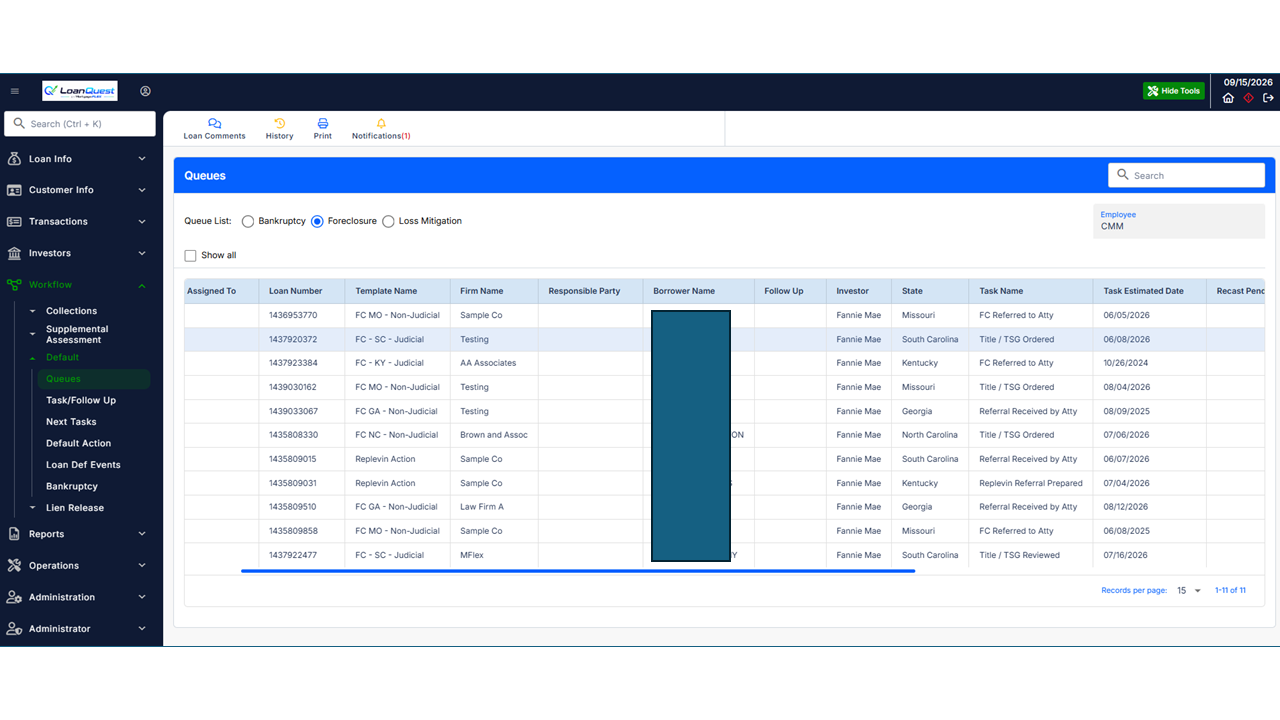
Templates, milestones, status tracking, holds, recasts, close reasons, and historical events — judicial and non-judicial.
Bankruptcy
Pre- and post-petition payment schedules, allocation, partial-payment tracking, delinquency visibility, reversals, and timeline reporting.
Loss mitigation
Configurable templates for reviews, tasks, deadlines, approvals, and resolution — with online borrower hardship submission.
Replevin
Chattel and manufactured-housing portfolios managed alongside conventional mortgage default in the same environment.
Supplemental actions
Non-standard workflows for code violations, delinquent taxes, inspections, complaints, deficiency follow-up, and claims.
From delinquency to resolution, in controlled steps.
Identify & route
Delinquency, status, freeze codes, system triggers, or user action place the loan into the appropriate queue and workflow.
Execute the plan
Users work assigned tasks from editable templates for collections, foreclosure, bankruptcy, loss mitigation, replevin, or supplemental action.
Coordinate decisions
Holds, recasts, approvals, denials, close reasons, and exception handling create controlled decision points with recorded outcomes.
Collaborate securely
Approved attorneys and vendors act on assigned work using restricted access, while the servicer retains oversight.
Communicate & document
Letters, notices, comments, borrower documents, and workflow evidence stay associated with the loan for future reference.
Monitor & report
Queues, dashboards, timeline reports, transaction history, and audit logs support management and compliance review.
Bankruptcy payment visibility
Bankruptcy handling is embedded in the servicing transaction history — pre- and post-petition obligations, suggested fund allocation, partial-payment visibility, remaining delinquency, reversals and reapplication, and imported history for acquired loans with an existing bankruptcy.
Foreclosure control without losing flexibility
Workflows reflect jurisdictional and operational differences while preserving a consistent management framework — state templates, judicial and non-judicial processes, historical actions, defined holds, recast requests, subcategories, close reasons, and full visibility until final activities complete.
Transparent history. Controlled collaboration. Open connectivity.
Integrated in servicing
Default activity is managed with the broader loan record, transaction history, documents, comments, borrower data, escrow, and reporting — reducing fragmentation.
Configurable by the servicer
Administrators can edit or create workflow templates, tasks, assignments, and milestones so operations evolve without redesigning the platform.
Task and queue driven
Work is presented through role-oriented queues and dashboards — ready, pending, on hold, overdue, or awaiting approval.
50-state process support
Delivered with foreclosure and replevin template support across all 50 states, adjustable to your requirements.
Controlled collaboration
Approved attorneys, law firms, delegated agents, and vendors receive restricted access to assigned loans and relevant tasks.
Open connectivity
APIs support synchronization with a servicer's system of record — milestone-related activity — to reduce duplicate entry.
Third-party task collaboration
Built for multiple operating models.
Reduce manual tracking
Replace spreadsheet calendars and follow-up emails with queue-driven tasks and visible ownership.
Improve consistency
Repeatable templates, dependencies, decision controls, and documented close criteria.
Strengthen oversight
Clear view of open work, holds, recasts, aging, milestones, and exceptions.
Compliance readiness
User-level audit logs, workflow history, documents, notices, and configurable state processes.
Designed for
- Full-service mortgage servicers seeking one system for servicing and default
- Specialty servicers — replevin, manufactured housing, chattel, business-purpose
- Organizations using MortgageFlex default while retaining another system of record
- Banks, credit unions, state agencies, and mortgage companies
Workflow controls
- Due dates and task sequencing
- Department, role, user, attorney, or vendor assignment
- Dependencies and float-day logic
- Holds, hold reasons, and recast approval decisions
- Close reasons and queue-removal rules
- Comments, documents, notices, and completion evidence